
CPQ for Truck Manufacturers: Configuring 500+ Options per Unit
How truck OEMs and bodybuilders use CPQ to sell chassis with hundreds of interdependent options, modelling patterns, EV/emissions complexity, and integration touchpoints.

The problem specific to trucks
Passenger cars are configured from a few trim levels and a handful of options. Heavy trucks are the opposite: almost everything is a decision, and almost every decision has physical consequences. A longer wheelbase changes the turning circle, which changes what bodies fit; a heavier engine changes the front axle load, which changes what tyre pressure classes are legal; adding a PTO changes gearbox options, which changes drivability ratings.
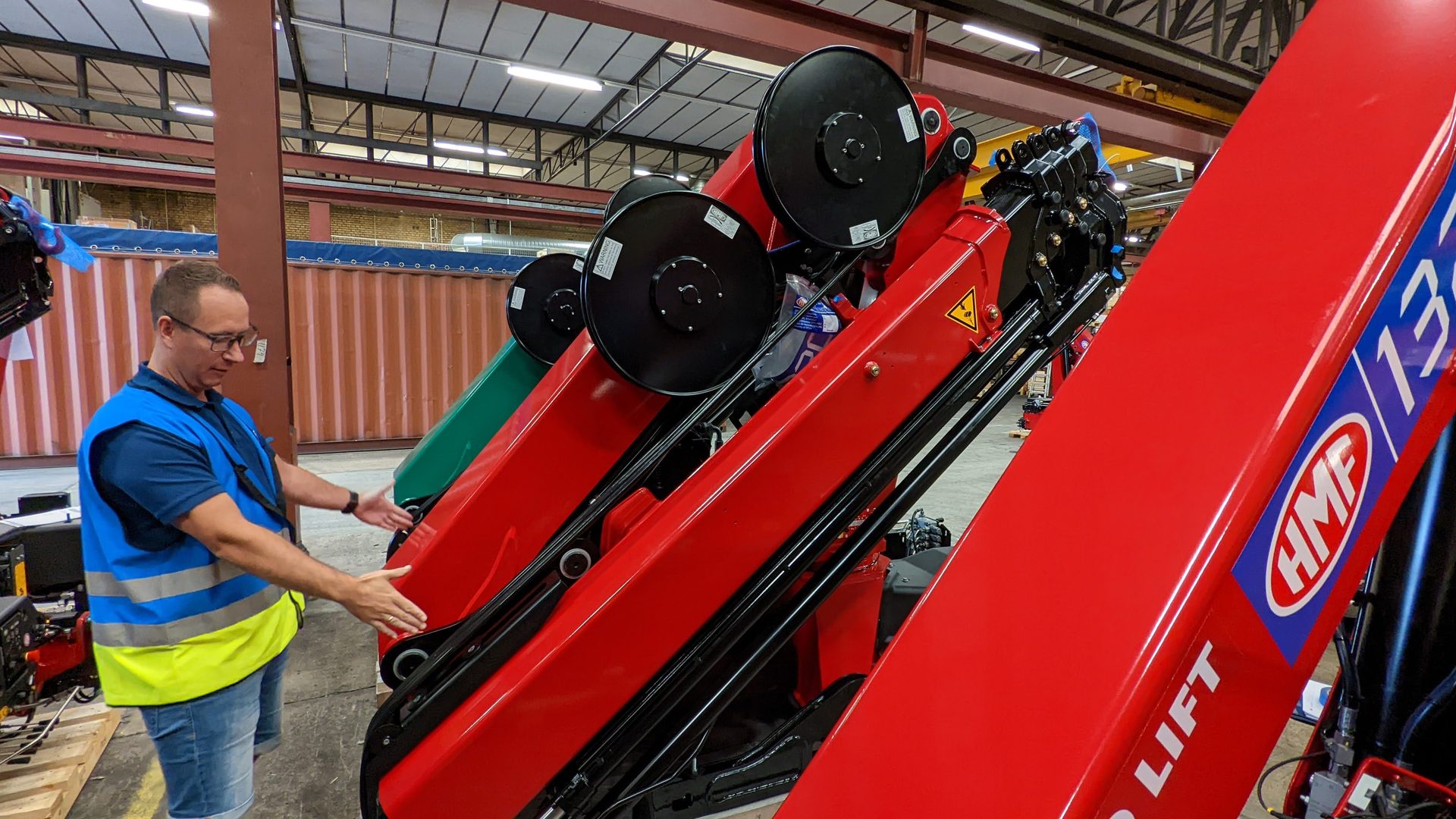
A CPQ model for trucks is not a form with 500 fields, it is a physics-aware rule graph where changing one option cascades through the rest of the configuration and either forces, forbids or reprices dozens of others. Our customer HMF Cranes builds on exactly this pattern for loader cranes mounted on truck chassis: the crane configuration and the chassis configuration constrain each other in both directions.
The modelling pattern that works
We use a three-layer model on every truck deployment:
- Commercial layer, the salesperson's view: intended use, payload, route profile, country of registration. No engineering vocabulary.
- Technical layer, the derived chassis specification: wheelbase, axle configuration, engine, gearbox, cab. Populated automatically from the commercial layer, overridable by product specialists.
- Homologation layer, country and regulation constraints applied on top. Nothing is quotable that is not legally deliverable in the target market.
Each layer is owned by a different team internally: sales for layer 1, product management for layer 2, compliance for layer 3. CPQ is the only system where they meet. This is the same guided-selling principle that applies across manufacturing CPQ, just with far higher constraint density than most industries ever encounter.
What's changed for 2026: EV, Euro 7 and AI-assisted configuration
Three shifts are reshaping truck CPQ models since we first wrote this guide:
Electric powertrains turn a technical trade-off into a commercial one. Battery pack size trades directly against payload and range, a decision a salesperson now has to explain, not just an engineer. The CPQ model has to surface that trade-off in commercial terms ("this pack gets you 300km of range but costs 800kg of payload") instead of leaving it buried in a technical spec sheet the customer never sees before ordering.
Euro 7 and market-specific emissions rules add another homologation dimension. Emission class now interacts with engine choice, exhaust after-treatment hardware, and in some markets registration eligibility by date, all of which the homologation layer has to encode per destination market, on top of the existing axle-weight and hazard-signage rules.
AI is changing the front end, not the constraint engine. The validity logic stays rule-based, a truck that violates axle load or homologation rules is illegal no matter how it was configured, so a constraint solver still owns that layer. What AI-assisted configuration adds well is turning "pick from 700 options" into a short guided conversation based on intended use, then handing the result to the same rules engine for validation. See our take on where AI genuinely helps CPQ for the boundary between the two.
Integration with ERP and manufacturing
A truck quote is worth six figures and locks capacity months in advance. That means the CPQ output has to be more than a PDF. Standard integration touchpoints on truck programmes:
| Downstream system | What CPQ sends | Timing |
|---|---|---|
| ERP (order & BOM) | Configured BOM, priced line items, delivery week | On order acceptance |
| MES / production planning | Chassis specification for slot allocation | On confirmed slot |
| Homologation database | Full spec for type approval documentation | On order acceptance |
| Dealer DMS | Signed quote, deposit terms | On customer signature |
Pitfalls we see on truck programmes
Trying to model every option as equal. Not all options carry the same constraint weight. Cab colour has zero technical consequence. Engine choice has hundreds. Treating them symmetrically produces an unusable model.
Modelling from the catalogue instead of from the sales conversation. The option list is the output of a good CPQ model, not the input. Start with how sales actually asks the customer questions.
Underestimating homologation churn. Regulations change every year in multiple markets, Euro 7 is only the latest example. Budget for a small permanent team maintaining the homologation layer, a CPQ project that ends at go-live decays fast.
If you want to feel the bodybuilder side of this rather than read about it, our mobile CPQ demo rotates through real products, one a day, and the hooklift among them runs on exactly the kind of body-to-chassis rules described above, on your phone, with no login.
For more on total cost of a truck CPQ programme, see our CPQ pricing guide. For a general primer, see what is CPQ, and for the vendor landscape behind these deployments, our comparison of the top CPQ vendors.
Frequently asked questions
Related posts
How medical device and healthcare equipment manufacturers use CPQ to quote complex, compliant products fast, without errors reaching production.
When CPQ user experience is shifting from rule-based logic to interactive, dialogue-driven configuration, engagement, and trust in complex B2B sales.
Scania's remanufactured gearboxes are revolutionizing sustainable manufacturing and transforming CPQ systems for a more efficient and eco-friendly future.